
Housing in numbers
How much money could you have when you move?
Part of a mortgage payment can build equity. Selling costs take a bite out of it. See how a buyer and a renter fare if they move after two, five or ten years.
U.S. families who own their homes
How much equity do homeowners have?
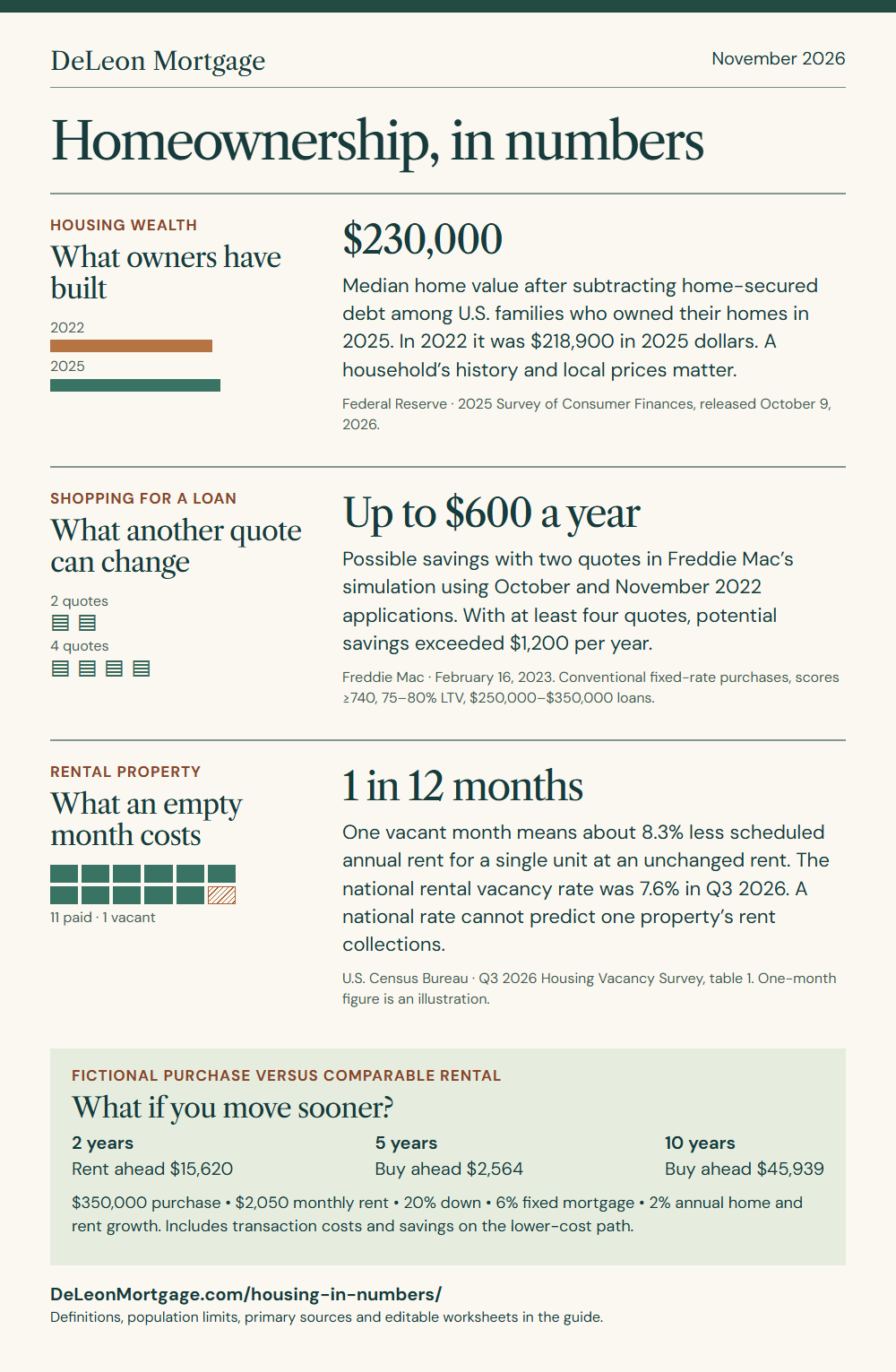
In 2025, the median family that owned its home had $230,000 in net housing value. That is the value left after subtracting debt secured by the home. Half of owner families were above the median and half below.
A down payment, years of principal payments and changes in property value can all contribute. These survey snapshots include long-time owners and people with no mortgage. They cannot tell a new buyer how much wealth borrowing will create.
Federal Reserve · 2025 Survey of Consumer Finances · October 9, 2026.
A worked example
How long would you keep the home?
Here two households start with the same savings. One buys a $350,000 home with 20% down. The other rents a similar home for $2,050 a month. Each household saves the difference in months when its housing costs are lower. The figures below show what each would have when they move, rounded to the nearest dollar.
After 2 years
Renting comes out ahead by $15,620. The buyer has paid down $7,089 of loan principal.
After 5 years
Buying comes out ahead by $2,564. The buyer has paid down $19,448 of loan principal.
After 10 years
Buying comes out ahead by $45,939. The buyer has paid down $45,680 of loan principal.
Numbers behind this example
Fictional assumptions: 30-year fixed mortgage at 6%, $7,500 purchase costs, selling costs of 5% of the future sale price. Monthly taxes, insurance and upkeep start at $320, $130 and $220. No association dues or mortgage insurance. The rental deposit is $2,050, returned at exit, and renter insurance is $20 per month.
The example assumes home value, rent and recurring ownership expenses rise 2% a year, with a 3% effective annual return on side savings. Taxes on gains, tax deductions, moving costs and shocks are excluded. A fall in home value or a large repair changes the result.
| Stay | Buyer | Renter |
|---|---|---|
| 2 years | $73,022 | $88,642 |
| 5 years | $106,555 | $103,990 |
| 10 years | $170,995 | $125,056 |
Change the rent, purchase price or growth assumptions · CFPB · how mortgage payments build equity.
The cost of borrowing
What can a second quote change?
In a Freddie Mac simulation using October and November 2022 applications, choosing the lower of two quotes could save as much as $600 a year. With at least four quotes, potential annual savings exceeded $1,200.
The study compared similar 30-year conventional fixed-rate purchases. Applicants had credit scores of at least 740, loan-to-value ratios of 75%–80% and loans of $250,000–$350,000. The result describes rate differences in those months. Fees, points and today’s written offers determine your own comparison.
Compare two written Loan EstimatesFreddie Mac · rate-shopping simulation · February 16, 2023.
For rental owners
Would a missed month of rent change the plan?
The Census Bureau estimated that 7.6% of U.S. rental housing inventory was vacant and available for rent in the third quarter of 2026. One year earlier it was 7.1%. These national estimates describe a stock of homes. Your unit’s occupied months and rent collections depend on that particular property.
In a one-unit rental, one full month without a tenant removes about 8.3% of that year’s scheduled rent, assuming the same monthly rent all year. The mortgage payment still falls due.
Stress-test a vacancy · Look up local housing data11 months collected. 12 months of bills.
U.S. Census Bureau · table 1, Q3 2026 (PDF) · October 28, 2026. The Bureau reports survey uncertainty and significance in its release.
Download the illustrated summary (PNG)
Sources checked November 21, 2026. Historical survey results, modeled savings and fictional examples are labeled separately.